


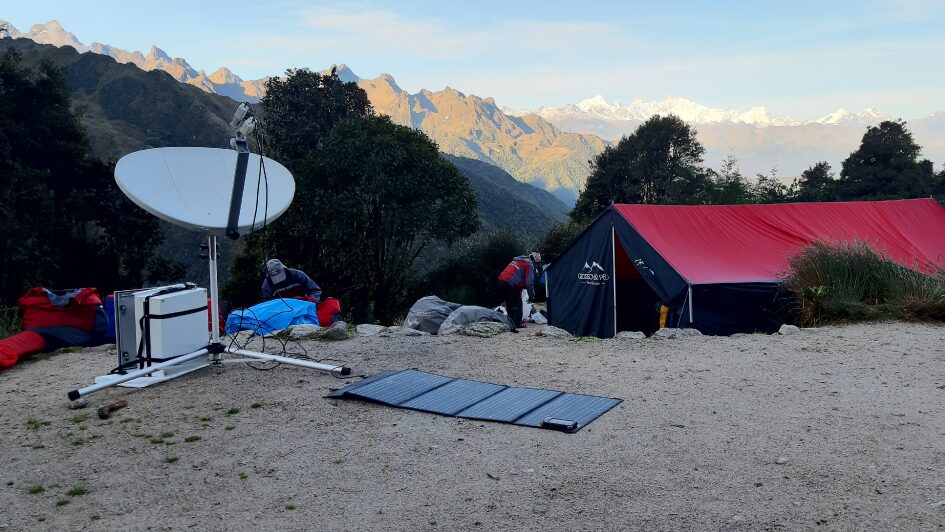
At the first campsite, someone takes out their phone, checks the battery and asks if there is an outlet in the tent. There isn’t. There isn’t one at the second or third campsite either. The next outlet is in Aguas Calientes, when the trek is already over.
During the four days of the Classic Inca Trail, there is no electricity for passengers. Anything you use comes from the charge you brought from Cusco.
Why there are no outlets on the route
The campsites (Wayllabamba or Ayapata, Pacaymayo or Chaquicocha, and Wiñay Wayna) are inside a protected area. There is no power grid. Anything that arrives, arrives on foot.
Some operators use a radio or satellite equipment for emergencies. That is not a charging service or Wi-Fi for the group. The kitchen generator, if there is one, is not intended for your phone either.
On the 2-day Short Inca Trail, you spend the night in a hotel in Aguas Calientes. There are outlets there. Not on the hiking day.
Signal and battery
There is almost no coverage along the route. At some high points, a weak bar appears. Near Wiñay Wayna, it sometimes returns for a while. It is not something you can rely on.
A phone without signal uses battery just searching for a network. That is why it is best to keep it in airplane mode from the moment you leave Cusco. It still works as a camera, alarm and offline map.
The guide maintains emergency communication with the base. You do not need to keep your phone on for the team to know where the group is.
What power bank to bring
For the 4-day Classic Inca Trail, if your phone is your main camera, a 10.000 mAh one is enough if you take photos wisely and do not watch videos at night. A 20.000 mAh one gives you more leeway if you record videos or someone in the group runs out of charge.
A 5.000 mAh one is not enough. A very large one adds weight and can cause problems on the plane.
Charge it to 100 % the night before at your hotel in Cusco. Check that the cable is the right one for your phone. If it is USB-C, bring that one.
Keep the power bank in your daypack, inside a zip bag. Not in the duffle bag. The duffle bag travels with the porters, can get wet and is not within reach at midday.
How to make your phone last
Treat it as gear, not entertainment.
Airplane mode from day one. Low brightness. Close WhatsApp and social media: they search for a network even when there is none. Do not use it as a flashlight; that is what your headlamp is for. Review photos at night, not at every stop.
If you want music, download it in Cusco and play it offline. Or leave it behind. The trail does not need it.
Save battery for Machu Picchu. Reaching Inti Punku with 4 % on your phone is a story told far too often. Having 30 % for that morning is usually the reasonable minimum.
Cameras, GoPro and spare batteries
If you bring a separate camera, do not plan on recharging it along the route. Bring extra batteries, already charged.
For a compact or mirrorless camera, two or three batteries cover the four days. For a DSLR, three, especially if you shoot in cold weather or with the screen on. For a GoPro, two or three plus the case.
No drone. They are prohibited in Machu Picchu and the sanctuary.
The cold at the second campsite, the highest one, reduces battery life. A battery that lasts all day in Cusco may drop to half in Pacaymayo. Spare batteries are better kept in an inner pocket than at the bottom of your backpack.
Bring an extra memory card. Running out of space on the day you reach Wiñay Wayna cannot be fixed on the trail.
Headlamp and the rest
A headlamp is not optional. On the last day, you set off at night toward Inti Punku. If it charges by USB, leave it at 100 % in Cusco and use it sparingly on the first nights. If it uses AA or AAA batteries, one spare set is enough.
A GPS watch lasts several days if you do not keep the screen always on. You do not need to charge it every night.
Kindle, tablet or speaker: better left at your hotel in Cusco. They weigh you down and use up charge you will want for photos.
Solar charger
During the dry season, there is sun at the high passes. There is also cloud forest, unexpected rain and hours of hiking with your backpack in the shade. A panel hanging from your backpack produces little power and gets tangled.
If you already bring a 20.000 mAh power bank charged in Cusco, the panel barely adds enough to justify its weight. It makes more sense on longer treks.
Rain and cold
The cloud forest gets things wet without warning. Keeping your phone in the outer pocket of your jacket is not enough.
Put your phone, power bank and batteries in a zip bag or small dry bag. At night, keep the power bank and camera batteries close to your body or inside your sleeping bag: cold drains them even when they show a charge.
Do not leave your phone on the dining tent table. There is condensation and the risk of knocks.
If you shoot in drizzle, cover the lens. It fogs up when moving from the morning cold to the humid valley.
Power bank on the plane
It goes in your carry-on luggage, never in checked baggage. The usual airline rule is not to exceed 100 Wh, which in practice is around 27.000 mAh. A 10.000 or 20.000 mAh one is allowed without issue if it is labeled.
If you bring two, both must go in the cabin. At security, they may ask to see them. Keep them handy.
Charge them at the hotel the night before the trek, not at the airport at the last minute.
Where you can plug in again
In Aguas Calientes, after coming down from Machu Picchu. Hotels, hostels and several restaurants have outlets. In Peru, the electricity is 220 V. If your chargers use a different plug type, bring an adapter.
If you are leaving early by train the next day, charge up as soon as you drop off your backpack. Do not leave it until the evening.
In Cusco, on the night before, the routine is the reverse: phone, power bank, headlamp and camera batteries at 100 %. That is the last reliable outlet until town.
Frequently asked questions
Can you charge your phone on the Inca Trail?
Not on the 4-day Classic Inca Trail. There are no outlets for passengers at the campsites. You need to bring a power bank. On the 2-day Short Inca Trail, you can charge at your hotel in Aguas Calientes, not while hiking.
Is there Wi-Fi to send photos?
Not reliably. There may be intermittent signal near Wiñay Wayna and regular coverage in Aguas Calientes. Upload your photos at the end.
What power bank capacity do you need?
10.000 mAh if you use your phone in airplane mode and take few photos. 20.000 mAh if you record videos or want more leeway. Charge it in Cusco and keep it in your daypack.
Can you charge a camera at the campsite?
No. Bring spare batteries that are already charged. The cold on the second day drains them faster.
Does the agency provide a charger?
Do not assume so. The support team is not a charging service.
What happens if my battery runs out on the day I visit Machu Picchu?
Tell your guide. Someone in the group usually has some power bank charge. It is not a plan. Save battery for Inti Punku and the visit.
Can I leave the power bank in the duffle bag?
No. If it gets wet or arrives late at the campsite, you will be without charge halfway through the day. Keep it in your daypack, inside a waterproof bag.