


If you ask anyone who has completed the Classic Inca Trail which day was the toughest, the answer will almost always be the same: the second day. It is the day everyone remembers, the one most feared before setting off, and the one that brings the greatest sense of achievement when completed. Here, you will see exactly why the second day brings together the greatest challenge of the entire route and how to tackle it in the best way.
The ascent to Dead Woman’s Pass
The heart of the second day’s difficulty is the ascent to Dead Woman’s Pass, known as Warmiwañusca. It is the highest point of the entire trek, at more than 4,200 metres above sea level, and reaching it involves a long, steady climb from the first night’s campsite.
This ascent combines two factors that intensify one another: a steep incline over stone steps and increasing altitude, where the air contains less and less oxygen. This combination is what makes this climb the greatest physical challenge of the trek.

Why altitude makes the difference
What makes this day so difficult is not just the climb, but doing it in the highest section of the route. At this altitude, every step requires more effort because the body receives less oxygen, and exertions that would be manageable at lower elevations become noticeably harder.
It is also the moment when it becomes most apparent whether prior acclimatisation was sufficient. Those who arrived in Cusco early to adapt to the altitude usually handle this ascent better, while those who did not strongly feel the effects of insufficient acclimatisation here.
The descent also takes its toll
Getting over the pass is not the end of the day. After reaching Warmiwañusca comes a long descent to the second night’s campsite, and going down steep stone steps presents its own challenge, this time for your knees and thighs.
After the effort of the ascent, this prolonged descent is felt in already tired legs. That is why many hikers agree that the second day is exhausting from start to finish: first because of the climb at high altitude, then because of the descent that puts strain on the joints.
How to tackle the second day
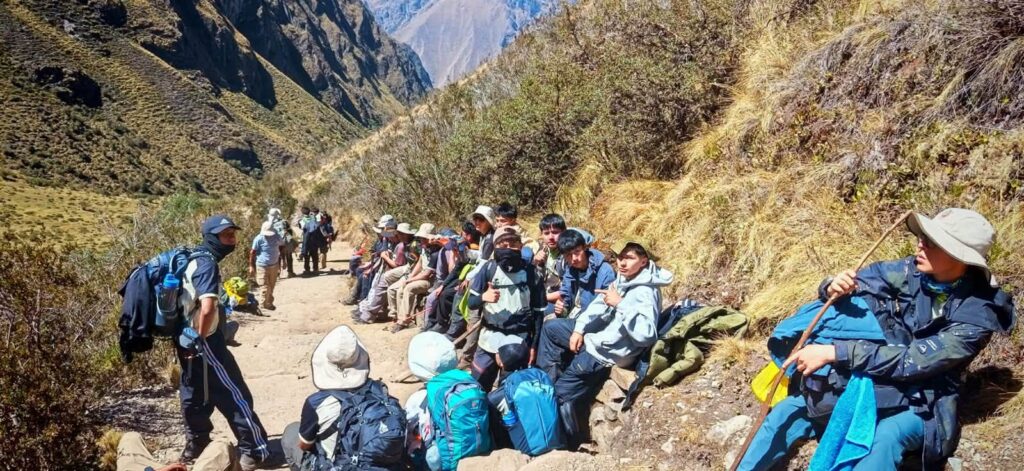
The key strategy for this day is pacing. During the ascent, moving slowly and steadily, taking deep breaths and frequent breaks, is far more effective than trying to climb quickly and exhausting yourself. It is not a race, and reaching the pass takes time regardless of your pace.
Trekking poles are a great ally both on the ascent and, above all, on the descent, as they distribute the effort and protect your knees. Staying well hydrated, eating energy-rich snacks during breaks, and trusting the pace set by your guide complete the formula for successfully getting through the day.
The reward after the effort
It is worth remembering that once you have completed the second day, the hardest part of the route is behind you. Reaching the highest pass brings an enormous sense of achievement, and the following days, although still demanding, are considerably more manageable. The second day is the peak of difficulty and also a turning point.
How to avoid the toughest second day
If the challenge of Dead Woman’s Pass concerns you, it is useful to know that not all versions of the Inca Trail include it. The 2-day Short Inca Trail follows part of the original trail without going near this high-altitude pass, avoiding the most demanding day of the classic route.
For those who want the complete experience and the challenge of reaching the highest point, the 4-day Classic Inca Trail offers exactly that achievement. With good acclimatisation and the right pace, the feared second day is a completely manageable challenge and one of the most memorable experiences on the route.
Frequently asked questions
Why is the second day the most difficult?
Because it includes the ascent to Dead Woman’s Pass, the highest point on the route at more than 4,200 metres. It combines a steep climb with the highest altitude, making the effort feel much harder than on other days.
What is Dead Woman’s Pass?
It is the popular name for Warmiwañusca, the highest point of the Classic Inca Trail, at more than 4,200 metres. It is crossed on the second day and is the greatest physical challenge of the entire trek.
Is the second day’s descent also difficult?
Yes. After reaching the pass, there is a long descent down stone steps that puts strain on the knees, with your legs already tired from the ascent. That is why the day is demanding from start to finish.
How can I better handle the second day?
Move slowly and steadily during the ascent, with breaks and deep breaths. Trekking poles help on both the climb and descent, and good prior acclimatisation is essential for coping with the altitude.
Is there a version that avoids this day?
Yes. The 2-day Short Inca Trail does not pass through Dead Woman’s Pass, so it avoids the most demanding day. It is an option for those who prefer not to tackle the highest point of the route.