


Above the highest pass on the route, at more than 4 200 m s. n. m., there is always someone with their arm outstretched and phone held high, slowly turning around in search of a single bar of signal. Sometimes a message goes through, and sometimes nothing happens. That scene sums up connectivity on the Inca Trail: four days when your phone works mainly as a camera and a clock, with occasional moments of coverage that cannot be planned. It is worth knowing this before you set off, especially so you can let the people waiting for you at home know.
The short answer
There is no stable connection during the Inca Trail. There are occasional spots with some signal, mostly in high and open areas, and entire stretches with nothing at all. There is also no wifi at any campsite.
The connection only returns when you arrive in Aguas Calientes on the final day. Plan for those four days assuming you will be out of touch, and treat any signal you get as a bonus.
Where you might find some coverage
Signal depends on having a clear line of sight to the antennas in the valley, so it appears in open, high areas and disappears in the deep ravines where the campsites are located.
| Section | Coverage |
|---|---|
| Ollantaytambo and the road to the trailhead | Good |
| Entry checkpoint and first valley | Intermittent |
| High areas and mountain passes | Occasional, depending on provider and weather |
| Campsites | Very weak or none |
| Cloud forest on day three | None for most of the section |
| Final campsite | Weak in some spots |
| Aguas Calientes | Full coverage, with wifi in hotels and businesses |
Coverage also varies depending on your SIM card provider. A Peruvian SIM card usually works better in rural areas than a foreign phone on roaming.
Why there is no wifi at the campsites
Inca Trail campsites are within a protected area, with no permanent service facilities. Everything at the campsites is carried in by Porters and packed up when the group moves on.
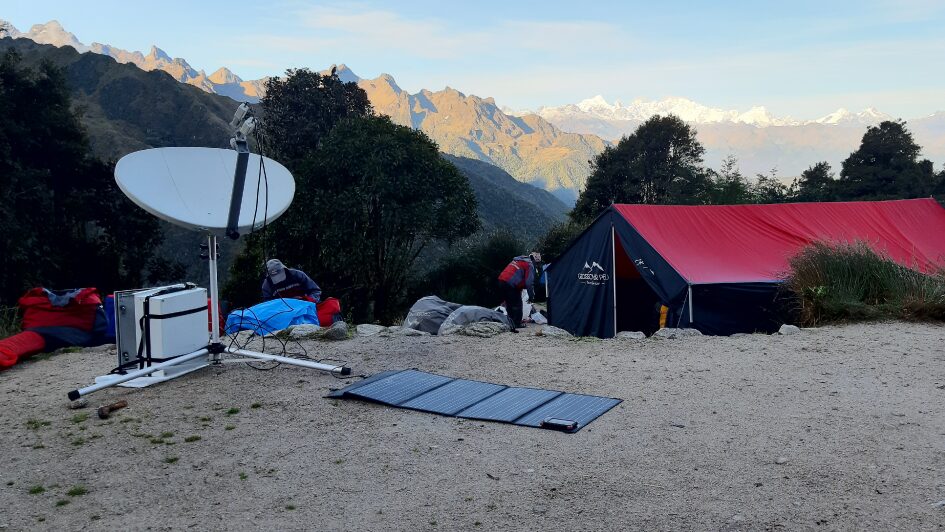
This sets it apart from other routes in the region, where some private campsites offer paid satellite internet. That is not an option here.
Battery life is the real issue
More than signal, what limits phone use is power. There is no electricity at the campsites, so all four days depend on what you bring fully charged from Cusco.
There is one factor most people underestimate: the cold. Above 3 500 m s. n. m., nights get very cold and batteries drain quickly. A phone left outside your sleeping bag overnight may have considerably less charge by morning than it did before.
- Bring a high-capacity power bank that is fully charged.
- Keep your phone in airplane mode while hiking. Searching for signal without finding it uses the most battery.
- At night, keep your phone and power bank inside your sleeping bag.
- Lower the screen brightness and close background apps.
- Solar chargers perform poorly in the cloud forest: do not rely on them.
Keep your power bank in your daypack, not in the duffle bag carried by the Porters. Find out what goes in each one in duffle bag on the Inca Trail.
What to tell your family before you leave
This is the most important practical point in this article. Before starting the trek, let people know that you will be out of contact for four days and that silence does not mean anything is wrong.
Leave someone you trust with the agency’s name and phone number, along with your trekking dates. In a genuine emergency, the office can contact the guide through its own channels, which a family member cannot do on their own.
One message the day before and another when you arrive in Aguas Calientes will ease the worries of anyone waiting for news.
How the team communicates in an emergency
Just because you do not have signal does not mean the group is isolated. Professional agencies work with emergency protocols and their own communication equipment, such as radios or satellite phones, as well as coordination with staff at the route’s checkpoints.
It is a good question to ask before booking: what communication equipment does the guide carry, and what is the procedure if someone cannot continue?
Your phone as a camera
For most travelers, this is the main use of a phone during the trek. A few precautions can prevent disappointment.
Free up storage space before leaving, because without a connection you will not be able to upload anything to the cloud to make room. Keep your phone in a waterproof bag or an inner pocket when it rains, which can happen without warning in the cloud forest. And if you want to photograph Porters or local people, ask permission first.
Drones are not permitted either on the route or in Machu Picchu.
Four days without a screen
It is worth saying: many travelers end up appreciating the disconnection. Without notifications, camp conversations last longer and you spend more time taking in the scenery.
Before leaving, download anything you want to have available offline: music, a book, maps, or route information. And put your phone away when the guide is explaining something or the team is sharing something with the group.
When the connection returns
When you arrive in Aguas Calientes, you get full coverage and wifi in hotels, restaurants, and cafés. It is the moment when the whole group sits down to write home and upload photos.
Keep in mind that during high season, the town’s wifi becomes overloaded in the afternoon, when all the groups arrive at once.
Frequently asked questions
Is there wifi at Inca Trail campsites?
No. The campsites are inside a protected area and have no internet facilities. Wifi returns in Aguas Calientes.
Is it worth buying a Peruvian SIM card for the trek?
It works better than roaming in rural areas and is useful for the rest of your trip around Peru. Even so, you will not have coverage with any provider along most of the route.
Can I charge my phone anywhere along the route?
Do not count on it. The campsites do not have electricity, so a power bank is your only source of power during the four days.
How can someone contact me in a family emergency?
Through the agency office, which can contact the guide through its emergency channels. Give that contact information to the appropriate person before you leave.
Can I use my phone inside Machu Picchu?
Yes, for taking photos, as long as you follow the sanctuary rules. Drones and tripods are not permitted.