


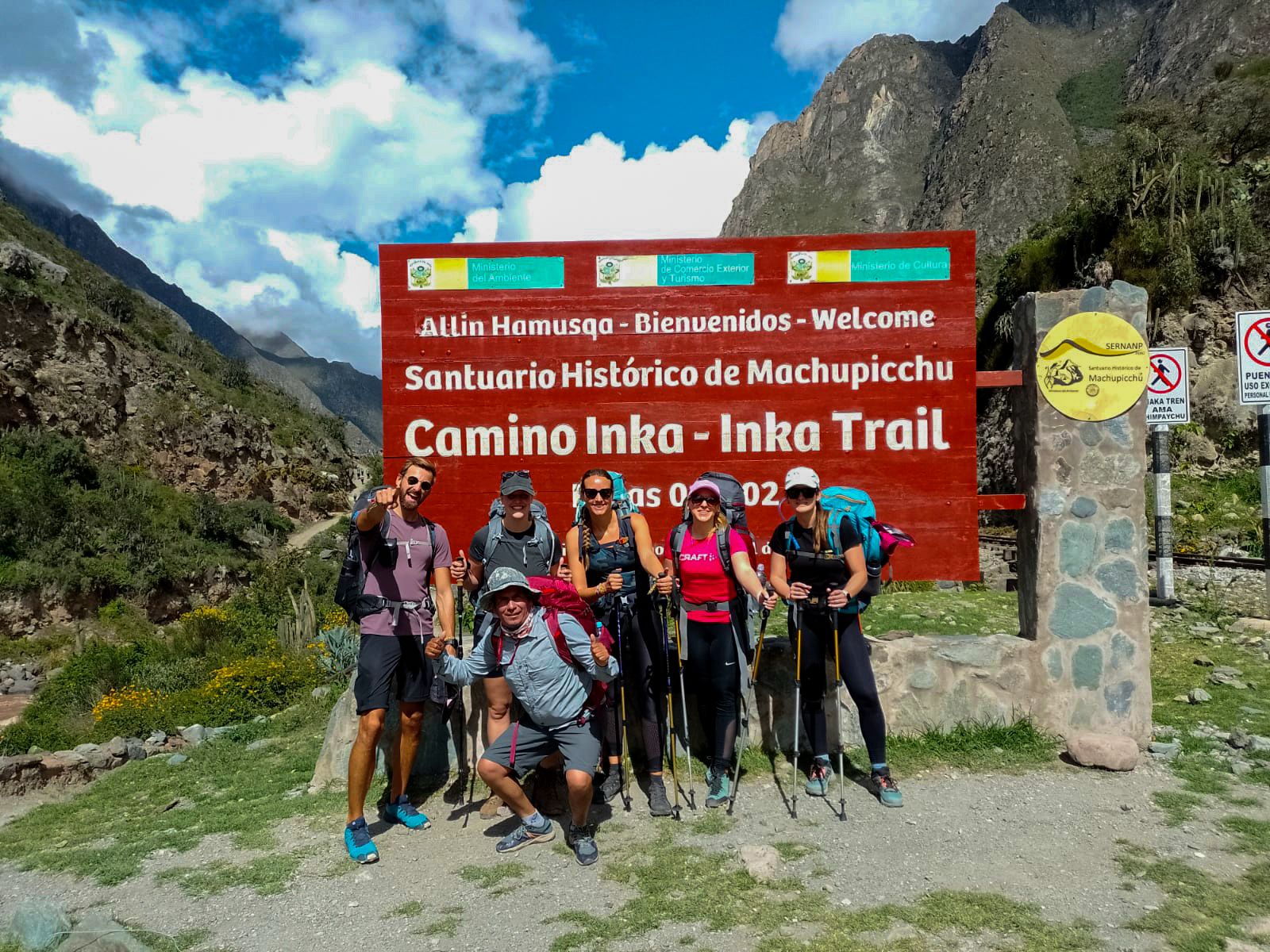
When someone says they are going to hike the Inca Trail, they mean something very specific: the stretch of stone-paved trail that climbs through the Andes and ends at Machu Picchu, with a named permit, a daily quota, and a mandatory guide. It is not a trek you can decide to do on the spur of the moment or hike independently. Here, we explain exactly what it is, where it goes, which archaeological sites it passes through, and what you need to hike it.
A section of a much larger network
The trek we now call the Inca Trail is a tiny section of the Qhapaq Ñan, the road system that connected the empire and which we cover in its own article. Here, we focus on the section that reaches Machu Picchu, the one hikers follow and the one with its own permits, quotas, and rules.
The Inca Trail to Machu Picchu
It is the route that climbs from the Urubamba River valley and reaches Machu Picchu through the Sun Gate, after several days of hiking along original stone-paved trails.
Its classic version takes four days, covering around forty kilometers with three campsites. It crosses mountain passes, valleys, and cloud forest, passing several archaeological sites that can only be seen by doing the trek.
The trail is within the Historic Sanctuary of Machu Picchu, a protected area, so its use is regulated and limited.
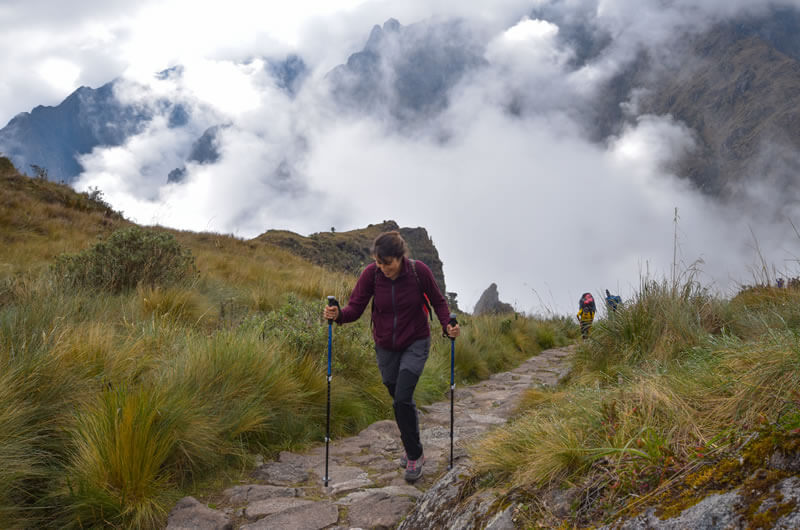
What you see along the route
More than a hike, the Inca Trail is a series of archaeological sites connected by a single trail.
- Patallacta, an agricultural complex with extensive terraces, visible from the trail during the first few kilometers.
- Runkurakay, a circular structure located beside a mountain pass that served as a checkpoint.
- Sayacmarca, perched on a cliff and reached by a narrow staircase.
- Phuyupatamarca, the town above the clouds, with water fountains that still function.
- Wiñaywayna, a complex of terraces and structures set on the mountainside, the last one before Machu Picchu.
- Intipunku, the Sun Gate, where the citadel comes into view for the first time.
The highest point on the Classic Inca Trail is Dead Woman’s Pass, above 4 200 m a.s.l., crossed on the second day.
A pilgrimage route
Experts agree that this section was not merely a communication route. Its layout, carved staircases, and the arrangement of its sites suggest a ceremonial journey to Machu Picchu, designed to culminate at the Sun Gate.
That is what sets it apart from any other trek in the region: here, the trail itself is heritage, not just the destination.
The routes available today
The authorized network has several entry points, which give rise to the different trek versions.
| Version | Duration | Best for |
|---|---|---|
| Classic Inca Trail | 4 days and 3 nights | Those who want the full route with campsites |
| Short Inca Trail | 2 days or 1 day | Limited time or a less physically demanding option |
| Extended versions | 5 days | Shorter hiking days and more time in Machu Picchu |
| Connection from Salkantay | 6 or 7 days | Those who want to add high mountains |
We explain the route that combines the Salkantay trek with the stone-paved trail in the Inca Trail route that connects with Salkantay.
How to visit: permits and rules
This is the part that surprises first-time planners the most.
- You cannot hike independently: an authorized agency and official guide are required.
- The permit is issued in your name, has a limited daily quota, and cannot be transferred.
- Dry-season spaces sell out months in advance.
- The route closes every February for maintenance.
- Pack animals are not allowed: porters carry the gear, subject to regulated weight limits.
- Camping is only allowed at authorized campsites, and all trash must be carried back out.
How gear transportation works within these rules is covered in duffle bag on the Inca Trail.
Difficulty and preparation
It is not a technical route, but it is demanding. It combines altitude, stone staircases that can be tough on the knees during descents, and several hours of hiking each day.
The most important thing is acclimatization: arrive in Cusco at least two days early. After that, well-broken-in footwear, layered clothing, and a slow pace take care of the rest.
When to go
The dry season, from May to September, offers the clearest days and also the largest crowds. April, October, and November have fewer visitors and a slightly higher chance of rain.
In February, the trail remains closed, although Machu Picchu stays open and can be reached by train.
Frequently asked questions
How many kilometers is the Inca Trail?
The classic version is around forty kilometers over four days. Short versions cover a fraction of that distance, while combinations with mountain routes exceed eighty.
Can you hike the Inca Trail independently?
No. You must book with an authorized agency and hike with an official guide. This is the main difference from alternative treks in the region.
What is the difference between the Inca Trail and Salkantay?
The Inca Trail follows Inca paths within a protected area, with a permit and quota. Salkantay is a mountain route that does not require a named permit and can be done with more freedom, but it does not follow the stone-paved trail.
Is it suitable for beginners?
Yes, with prior preparation and acclimatization. Many people with no trekking experience complete it every season. Those unsure about their fitness can choose the short version.
When should I book?
As early as possible, especially if you are traveling between May and September. The quota determines the rest of your trip: first the permit, then flights, and finally hotels.