


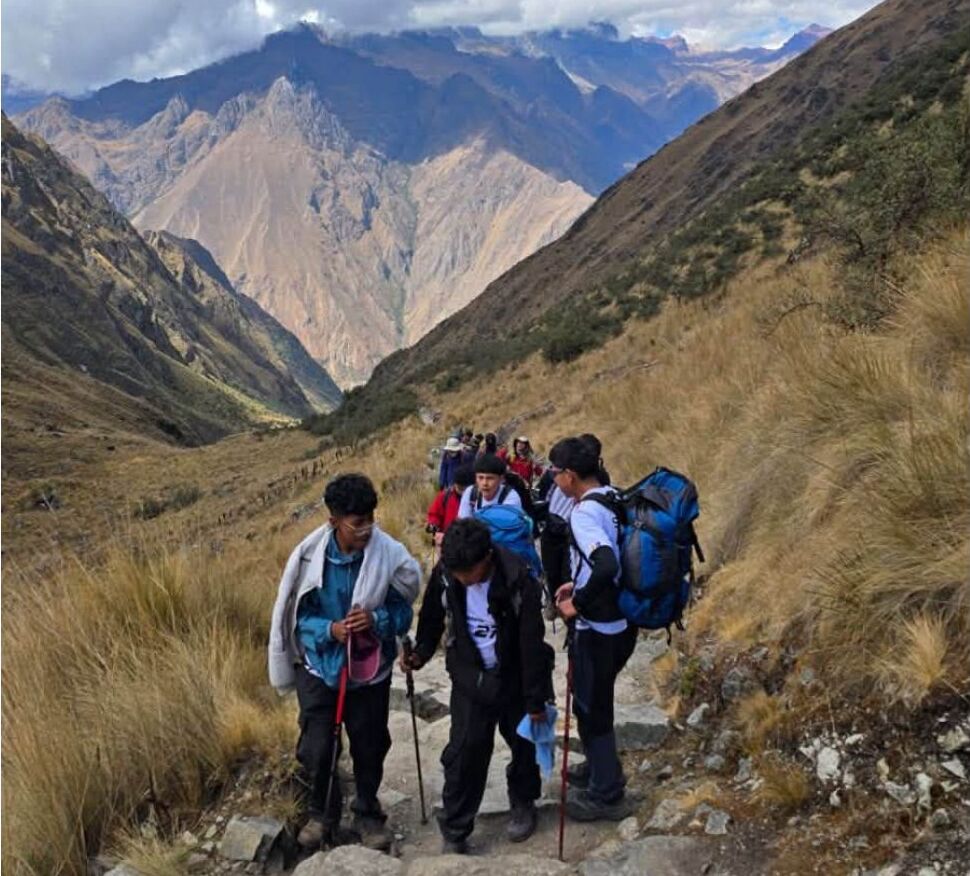
The guide names an apu and the group takes a photo. The cook leaves three coca leaves beside the pot. At camp, someone says ayni and nobody translates it. These are not brochure decorations. They are words that shape how permission is asked, how work is shared and how the trek comes to an end.
This is not a dictionary of greetings. It is a glossary of customs you will hear between Km 82 and Aguas Calientes.
What shapes the landscape
Apu. A mountain is not just a backdrop. It is an authority. Salkantay, Verónica or Huayna Picchu itself are called this when the guide asks for respect: do not shout at the pass, do not leave rubbish on the hillside. You do not need a ceremony to use the word. You need to avoid treating the summit as scenery.
Pachamama. The earth that gives and takes. On the trek, it appears in small gestures: a little drink poured onto the ground before the first sip, or leaves offered at the start of the day. It is not a show for tourists when the team does it quietly. If you are invited, follow the gesture. If not, do not stage it for the camera.
Waka. A site or stone with sacred significance. Not every wall at Sayacmarca is a waka. When the guide says it, they usually point to a specific place: a carved rock, a spring, a doorway. Walk around it, not on top of it.
Kintu. Three coca leaves together, right side up and unbroken. They are blown toward the apus or left in a place. It is a short request. It is not “trying coca.” It is the form of the offering.
Despacho. A more elaborate offering: paper, coca, fat, sweets, sometimes wine. On the Classic Inca Trail, it is not part of the itinerary. If a group does one, it is an extra and you will be told in advance. Do not demand it as if it were the photo at Inti Punku.
What shapes the work
Ayni. Help that is returned. At camp, you see it without any speech: someone holds one end of a tent, and shortly after, they are handed mate tea. Among Porters, it is the old rule. You are not part of that system, but you brush against it when a fellow trekker lends you soles or waits for you on the steps. Returning the favour in Aguas Calientes or in the tip envelope is not charitable tourism. It is about not remaining in someone’s debt.
Minka. Collective work for a common purpose. Heard less often on the trek than ayni. It may come up if the guide talks about how a section or a community is maintained. Do not use it as a synonym for a tip.
Carrier / porter. Both are used on the route. Their job is to carry the duffle bags, tents and kitchen equipment ahead of the group. There is a regulated maximum weight. Ask how many kilos yours carries and whether the operator complies. The term is not a souvenir.
Chasqui. A relay messenger of the Inca state. There are no chasquis on the trail today. The tampu at Runkurakay makes more sense when you know that someone once ran short sections and delivered messages. Do not call a porter a chasqui.
Tampu. A state stop: shelter, storage and relay point. Runkurakay is one. The campsite at Wayllabamba is not. Mixing up the two erases their original purpose.
What shapes the body and the table
Coca. A leaf, not paste. At altitude, it is chewed or taken as tea for mild discomfort. It does not replace acclimatisation in Cusco. The leaf is allowed through the sanctuary checkpoint; other products are not. If you are offered a kintu, do not swallow it whole as if it were a sweet.
Soroche. Altitude sickness. It is not Quechua from a school dictionary, but it is the word you will hear. Headache, nausea, restless sleep. Slow down. You do not “beat” it by pushing through at Warmiwañusca.
Chicha. In the valley, it is a corn drink. At the Classic Inca Trail campsite, it is not part of the menu. If it appears in a village on the first day, ask whether it is fermented chicha de jora or the sweet kind. Do not assume its alcohol content.
Mikuy. Food. The trek cook prepares meals for the group, not for a restaurant in Cusco. Special dietary requirements must be mentioned when booking, not at the first soup.
What brings the trek to an end
Tip. It is not a tax and it is not included in the ticket. It is a strong custom. It is collected on the last night, in an envelope, in soles, at camp. The guide will indicate the moment. It is not the place for a long speech or to pay by card.
Tupananchiskama. Until we meet again. The farewell you hear when the team says goodbye in Aguas Calientes or on the train. More precise than goodbye.
Añay. Thank you. The word that goes furthest with the person who served you for four days. Say it sincerely once, not at every selfie.
What is not a local custom
Calling every terrace “energy.” Putting on a porter’s chullo for a photo without asking. Leaving “biodegradable” rubbish on the hillside. Recording someone else’s offering. Speaking about Pachamama in a brochure voice and then tossing away your snack wrapper.
Custom shows in the volume. Those who live the term do not shout it to the group behind them.
Frequently asked questions
Do I have to take part in an offering?
No. If the team makes a short gesture and passes you leaves, you can join in or stay back. Nobody charges you for a despacho as an extra on the Classic Inca Trail.
Is coca mandatory for soroche?
No. It is an altitude habit, not a medicine. Acclimatisation in Cusco matters more than the tea on day 2.
Is ayni the same as a tip?
No. Ayni means returning help. A tip is the closing contribution in soles for the team. They overlap. They do not replace each other.
Can I call any beautiful mountain an apu?
Best to do so when the guide names it that way. On this route, some summits are treated as apus, while some hills are simply hills.
Do I need to memorise all these terms?
No. With apu, añay, tampu and knowing when to tip, you will do well on the trail. The rest comes in when someone uses it.