


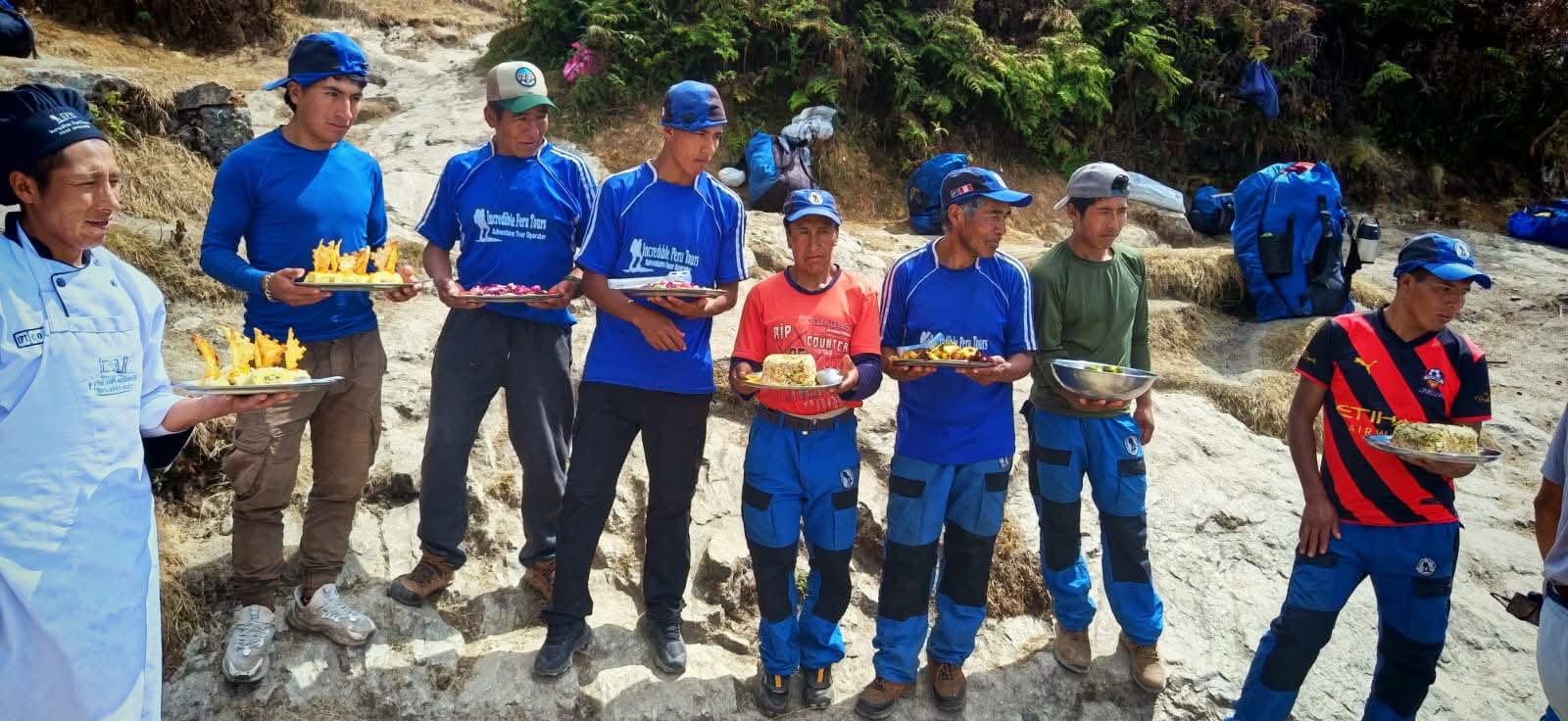
The trek crew speaks Spanish and English with you. Among themselves, and in the hamlets of Cusichaca, Quechua still comes first. You do not need a class. With ten words, you can understand the signs and greet people with more than just a wave.
Spelling changes depending on the sign: qhapaq or capac, ñan or nan, punku or punco. Here is the form you will see most often on the trail, with an approximate pronunciation.
Names you will read along the trail
| Quechua | How it sounds | What it means |
|---|---|---|
| Qhapaq Ñan | hah-pak nyan | Main road or road of the Lord. The Tahuantinsuyo road network. The trek to Machu Picchu is one section, not the entire network. |
| Warmiwañusca | wahr-mi-wah-nyoos-kah | Dead woman. Warmi means woman. Wañusqa, dead. The 4,215 m pass on day 2. |
| Llaqtapata / Patallacta | yak-tah-pah-tah | Village on high ground. Llaqta means village. Pata, terrace or high place. The Cusichaca grid layout. |
| Runkurakay | roon-koo-rah-kai | Basket house or round shelter. The oval tambo before the second pass. |
| Sayaqmarka | sah-yak-mahr-kah | Village standing upright. Sayaq, that which stands firm. Marka, village. The spur with the staircase. |
| Phuyupatamarca | phoo-yoo-pah-tah-mahr-kah | Village above the clouds. Phuyu means cloud. |
| Wiñay Wayna | wee-nyai wai-nah | Forever young. The name is linked to an orchid that blooms all year round. |
| Inti Punku | een-tee poon-koo | Sun Gate. Inti means the sun. Punku, gate. |
| Intipata | een-tee-pah-tah | Slope of the sun. Terraces near Wiñay Wayna, not the same site. |
| Wayllabamba | wai-yah-bahm-bah | Grassy plain. The first inhabited stretch after the checkpoint. |
| Pacaymayo | pah-kai-mai-oh | Hidden river. Mayu means river. Campsite below Warmiwañusca. |
| Machu Picchu | mah-choo peek-choo | Old mountain or old peak. Machu, old. Pikchu, peak. |
| Wayna Picchu | wai-nah peek-choo | Young mountain. The peak that completes the postcard view. |
Willkaraqay, Chachabamba, and Qunchamarka follow the same logic: an occupation plus a place. If your guide translates as you pass by, pay attention. The sign does not always match a desk dictionary.
Trail and campsite words
Ñan. Trail.
Tampu (tambo). A rest and relay stop. That is what Runkurakay is.
Chasqui. State relay messenger. It is not a present-day job on the trek. It is who used those tambos.
Andén. Farming terrace. The word passed into Spanish. In Quechua, you may hear pata or andan.
Apu. A mountain with authority. Your guide may mention it when Salkantay or Verónica come into view.
Waka. A sacred place or stone. Not every wall is a waka. Ask before using the word as decoration.
Inti. Sun.
Yaku. Water. Useful when asking for a refill.
Mikuy. Food.
Runa. Person. Runasimi is the name many people give the language: the people’s voice.
Tahuantinsuyo. The four regions together. The name of the Inca state, not a neighborhood in Cusco.
Phrases people actually use
Porters and cooks hear these every day. An añay when you hand back your cup is worth more than a speech.
| Quechua | How it sounds | English |
|---|---|---|
| Rimaykullayki | ree-mai-koo-yai-kee | Hello (respectful) |
| Allin p’unchay | ah-yin poon-chai | Good morning |
| Allillanchu | ah-yee-yan-choo | Are you well? |
| Allillanmi | ah-yee-yan-mee | I am well |
| Añay / Sulpayki | ah-nyai / sool-pai-kee | Thank you |
| Anchata añay | ahn-chah-tah ah-nyai | Thank you very much |
| Ari | ah-ree | Yes |
| Mana | mah-nah | No |
| Yaku, ama hina | yah-koo, ah-mah ee-nah | Water, please (short request) |
| Haku | hah-koo | Let’s go |
| Tupananchiskama | too-pah-nahn-chees-kah-mah | Until we meet again |
You do not need the full bathroom phrase. At camp, a hand gesture and your guide’s Spanish will do. At a stall in the valley, añay and hayk’a (how much?) are enough for coca leaves or a Gatorade.
How to read it without taking a class
The qh is not a soft k: it comes from farther back in the throat, like a dry h. Ll sounds like the Argentine ll or a y, depending on who is speaking. Ñ is like the ny in canyon. Stress usually falls near the end.
If you say it wrong, nobody will be offended. If you use it as decoration in every photo, it gets tiring. Once a day, when it fits, is enough.
Cusco Quechua is not the same as the Quechua spoken in Bolivia or northern Peru. The phrases above are the ones you will hear on this route. A dictionary from another region may disagree on spelling. On sanctuary signs, what is painted is what counts.
Frequently asked questions
Do I need to speak Quechua for the trek?
No. Your guide works in Spanish and English. Quechua helps you understand place names and thank the crew. It is not needed to request a permit.
Añay or sulpayki?
You will hear both. Añay is shorter and more commonly used with the group. Sulpayki sounds slightly more formal.
Why is the same place spelled three different ways?
Because Quechua has been adapted to the Latin alphabet several times. Sayaqmarka, Sayacmarca, and Sayacmarca on the map are the same village.
Do people say Machu Picchu in Quechua in town?
People say Machu Picchu. The translation “old mountain” is useful for a sign, not for asking for the bus.
Can I learn just these words on the plane?
Yes. Prioritize añay, yaku, haku, and the names of that day’s sites. The rest will come naturally when your guide points them out.